An Inside Look - First Youth Police Academy Provides Real-Life Training
August 7, 2015
-

- Staff photo by Doug Robinson Officer Megowen instructs the cadet class about the upcoming schedule of events during the Hudson Police Department’s Youth Police Academy held in the Ann Seabury room at the Hudson Police Department.
-
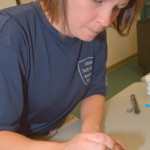
- Staff photo by Doug Robinson Officer Avery demonstrates the correct technique necessary for investigating and processing fingerprints.
-

- Staff photo by Doug Robinson Dressed in their T-shirt uniforms, Hudson Police Youth Academy cadets celebrate the moment.
-
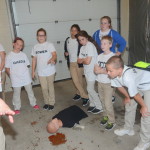
- Staff photo by Doug Robinson Youth Police Academy cadets work with Detective Cummings as they analyze the “murder scene” created in the Sally Port for their examination during the CSI curriculum.
-
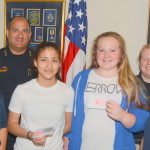
- Staff photo by Doug Robinson Winners of the fingerprinting contest, Cadet Officer Traverso (left) and Cadet Officer Merrow hold their winning fingerprints while Hudson Police Chief Jason Lavoie, officers Megowen (left), Cummings (rear) and Avery look on. “I’ve had a great time and I’ve learned a lot,” said Cadet Officer Merrow. Cadet Officer Traverso commented, “This has been a great experience, and I’m glad that I came.”
by Doug Robinson
Hudson youth, ages 10-14, were offered an opportunity of a lifetime with their invitation to interact with the Hudson Police Department during its first Youth Police Academy.
Twenty-eight Hudson youth signed up for the 12 available slots in the academy. “We increased our enrollment to 18, so that we could accommodate and have more kids attend,” commented Hudson Police Officer Rachelle Megowen, formerly the middle school resource officer.
Police cadets who wished to participate were required to write an essay as to why they should be accepted into the youth academy and also were asked to receive a favorable recommendation from their school guidance counselor.
Many of the police cadets wrote of their desire to be a police officer in the future and to learn more about the job. “I want to challenge myself to have a better understanding of law enforcement” and “I have a lot of questions and I am hoping this program can answer the important ones” wrote two cadets. “I want to learn how to make a difference and know how to help people” wrote another. Another cadet wrote, “Someday my name will be placed on a badge just for me.” And still another wrote, “I am glad you made this camp because I have been bugging my parents to find (one) just like this … I have desired to be a police officer since I was 7.”
Many young cadets referenced their experience in the D.A.R.E program and gave many compliments to the leadership offered by Officer Avery.
Various guidance counselor references were consistent with their recommendations of students who were considered to be “leaders,” disciplined students, and possessed the values of “volunteerism” and “helpful to others.”
During the week-long session, Megowen and Officer Cassandra Avery taught the cadets the principles of leadership, citizenship, public safety, and good policing, booking a prisoner, inside the police cruiser, drug safety, personal safety, building search, and the importance of being part of a team.
In addition, cadets received training on CPR, Police K-9, patrol duties, laws of arrest, and criminal investigations,
Detective Allison Cummings also taught the participants about “How to solve a crime scene,” much like the cadets see on television.
During one lesson, the cadets learn to take their own fingerprints by using the “fuming” method. This method involves the mixture of superglue, aluminum foil, and pipe cleaner to “raise” their fingerprint and transfer the image to a piece of paper. The cadets were challenged to see who could produce the best fingerprint possible.
“Don’t sweep the brush, spin it in a circle. Go slow and be gentle with the dust” instructed Officer Avery. “Your fingerprint is unique to you, only you. Your left hand and your right hand have different fingerprints. Your fingerprints develop between the ages of 12-18 weeks. They are special only to you.”
While Officer Avery demonstrated the correct technique and procedures to obtain a fingerprint, Officer Cummings was conducting her own CSI practical demonstration in the “sally port” or the garage area where prisoners are brought to the police station. Here, complete with ketchup to assimilate blood, a toy gun, knife, plastic bag of drugs (spices), a bloody handprint on the wall, two upturned glasses, one dead body (actually a CPR training dummy), fake footprints, and more ketchup droplets on the floor, the cadets were asked to analyze their observations and asked, “What would you do?”
“You have only chance to get a crime scene right” instructed Officer Cummings and “you must pay attention to every detail.”
Sgt. Dave Cayot, Support Services Division, stated, “(Officer Megowen) has done a great job with the creation of a new program, affording Hudson youth to interact with the police department. She had a great response to those who wanted to attend, and the class is going really well.”
Hudson Police Captain Bob Tousignant commented, “We have a Citizens Police Academy and we have Fright Night which afford those citizens and children of Hudson to interact with the Hudson Police Department. This youth academy is great because we now reach another age level of the population where we can invite them to the HPD and introduce the youth about policing, leadership, and public safety services. This is a great program.”